
At a time when the biopharma industry is seeking to increase U.S. manufacturing, Indiana is in the vanguard—and still expanding.
During a Nov. 11 BIO on the American Road visit, BIO President & CEO John F. Crowley praised the state’s role in advancing biotech research and manufacturing.
“Thriving ecosystems like Indiana’s don’t just happen. It takes great universities, a positive policy environment, an entrepreneurial mindset, capital, a trained workforce, and PURPOSE,” said Crowley, who has personal knowledge of Indiana universities as a graduate of Notre Dame Law School.
With more than 70,000 employed in the bioscience industry in 2023, Indiana is a production powerhouse, overtaking California in 2024 to become the nation’s top life sciences exporting state. Indiana’s life sciences industry provides “$27 billion in product exports and more than $99 billion in total economic activity,” according to Building Indiana.
The Biotechnology Innovation Organization (BIO) trip to Indiana was the last stop during 2025 for the BIO on the American Road tour—visits around the U.S. to learn more about the needs and unique features of the country’s biotech ecosystems. Crowley noted the depth of biotech in Indiana, from spinouts of academic institutions like Purdue, Indiana University and Notre Dame, to small and mid-size research organizations, to some of the world’s largest companies.
Eli Lilly’s global HQ
Indiana’s historical connection with the pharmaceutical industry goes back about 150 years. Eli Lilly has maintained their headquarters in Indianapolis since the company was founded in 1876.
It was therefore appropriate that Crowley’s visit began at Eli Lilly’s global headquarters, where he attended a meeting with the company’s government affairs team.
Eli Lilly is a leader in expanding domestic manufacturing and has announced $50 billion in investments in U.S. manufacturing facilities since 2020. In Indiana, these expansions will include new sites at the LEAP Research and Innovation District and the development of the Lilly Medicine Foundry, both in Lebanon, IND, and expansions and updates at Indianapolis manufacturing facilities, according to Inside Indiana Business.
This year alone, the company announced plans for four new plants in the U.S. worth $27 billion.
“We want our supply chains to be closer to our biggest markets, including, of course, the U.S.,” Dave Ricks, Lilly’s CEO, told The Washington Post when making the announcement in February.
Novartis’s RLT production
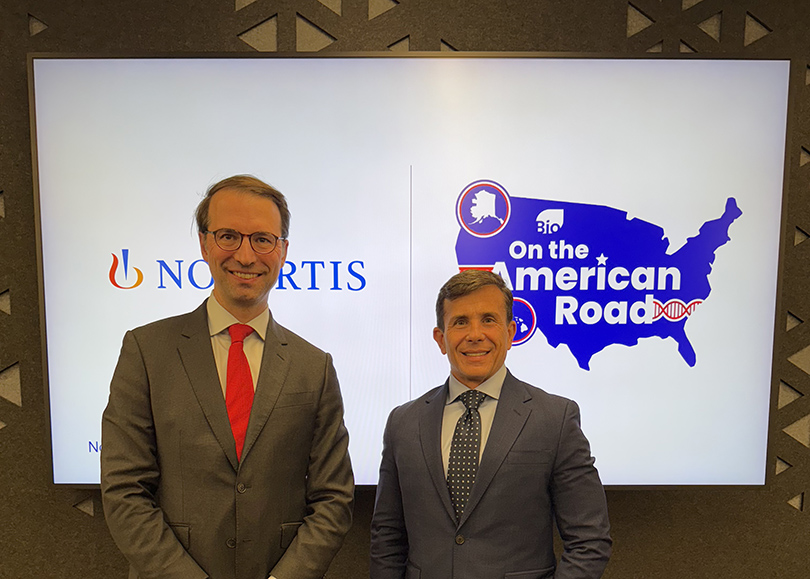
The next stop on the BIO tour was at a manufacturing site belonging to Novartis, which is also investing in expanding its U.S. manufacturing, with plans to spend $23 billion in U.S.-based infrastructure over the next five years.
Crowley visited one of the sites Novartis has slated for expansion, their 70,000-square-foot Indianapolis facility for producing radioligand therapies (RLTs).
RLTs combine a ligand, a compound that binds to a specific marker, with a radioisotope, to allow for more precise targeting of cancer cells, creating innovative medicines that will potentially transform oncology treatment and bring new options to people living with cancer. Novartis already has two RLTs approved for use in prostate cancer and gastroenteropancreatic neuroendocrine tumors, with other drugs in development.
“Novartis is actively investigating the application of RLTs across cancer types and settings, with one of the deepest and most advanced pipelines in the industry across prostate cancer, breast, colon, lung, brain, pancreatic and other cancers,” according to Victor Bulto, the U.S. President of Novartis, who is also a member of BIO’s Board of Directors. The RLT site in Indiana is one of those included in the firm’s plans for growth in the U.S.
“Radioligand therapy is emerging as a new pillar of cancer care, combining the precision of targeted therapy with the power of radiation,” said Bulto.
He said plans to expand the facility come in response to the growing demand for RLTs and will future proof the U.S. supply chain.
“Domestic production ensures rapid delivery of these time-sensitive therapies, which must reach patients within days of manufacturing due to the short half-life of the radioactive isotopes. Our Indianapolis facility, now the largest and most advanced of its kind globally, plays a critical role in meeting this demand.”
A radiopharmaceutical cluster
Novartis’s work helped Indiana gain the U.S. Patent and Trademark Office-approved title of “Radiopharmaceutical Capital of the World,” according to Bulto. “Our leadership in RLT and collaboration with local institutions like Purdue have helped position Indiana as a top state in life sciences exports,” he said.
Purdue University is also contributing to Indiana’s leadership in this field by establishing the first-ever Master of Science in Radiopharmaceutical Manufacturing. Kara Weatherman who helped establish the program, at Purdue, was in attendance during the BIO visit.
When developing the program, the university set up a consortium of companies involved in radiopharmaceuticals and asked, “What can Purdue do for you?” Weatherman said.
There were plenty of local firms available to join the coalition, as Indiana is home to 15 nuclear medicine companies, according to Purdue.
Bulto noted the importance of various biotech actors in the ecosystem.
“We know we can’t do it alone,” he said. “Delivering the next pillar of cancer care requires a highly specialized workforce and strong partnerships with healthcare providers, policymakers, academia, and national medical societies.”
The collaboration is apparently paying off.
“New technologies we had not even dreamed of 20 years ago are finally making their way to impact human life at scale,” Bulto told Crowley during the visit to Indiana. “At this facility we like to think we’re not just shipping doses, not just shipping medicine. We are shipping hope.”