
While the U.S. Food and Drug Administration (FDA) has faced significant change in recent years, industry leaders and agency officials alike say there are reasons for optimism.
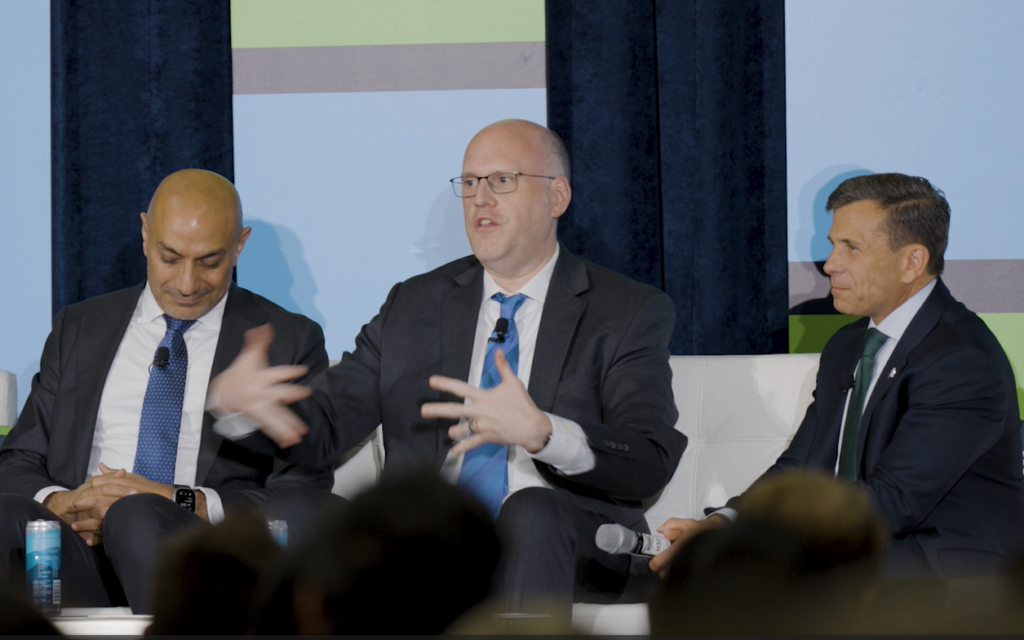
This was a key topic of conversation when John F. Crowley, President and CEO of the Biotechnology Innovation Organization (BIO), moderated a June 23 town hall with the agency’s newly appointed leaders at the 2026 BIO International Convention.
One major reason for this optimism: the recent effort to rebuild the FDA’s workforce and reestablish the agency’s institutional knowledge.
Maintaining core principles, while evolving for a new era
“Priority number one is to ensure we are there to support the companies that are innovating, and that we can deliver what they will deliver, and can also ensure they advance,” said Karim Mikhail, B.Pharm, MSc, Acting Director of the Center for Biologics Evaluation and Research (CBER).
“The second priority is that we have a number of open files, some of them the second or third resubmissions, and we want to make sure that we have operational continuity, and that we address some of these challenges together with them,” he continued.
“Number three is to think about the future,” he said. “Are we equipped to handle not only the challenges of June or July 2026, but are we equipped to think about the future? Because if we don’t do this now, very quickly, we are behind.”
Predictability is another priority, added Lowell Zeta, J.D., Acting Chief of Staff at the Office of the Commissioner. This is important so that the FDA can maintain what has worked, while updating execution to meet the needs of an ever more rapidly paced world.
“Our core pillars remain the same,” he said, listing “more cures,” “healthier foods,” “chronic disease, global competition and resiliency, and national security.”
“Our execution has changed a bit,” he continued. “Where we’re working really closely now in this phase with center staff to make sure that we have not just made the right changes, but they’re sustained.”
Why FDA workforce development and retention are key
FDA leaders understand that workforce development and retention are key to meeting these goals.
“My top priority for this initial period in this role is really fortifying the center, and specifically the workforce,” said Michael Davis, M.D., Ph.D, Acting Director of the Center for Drug Evaluation and Research (CDER). Boosting morale is also top of mind as he helps develop the organization’s workforce.
“One thing we are laser-focused on is retaining the amazing staff,” he continued. “You may read about the loss of institutional knowledge and people retiring, and so forth, and that’s true, but what I’ve really seen and appreciated is that the wonderful office leadership at CDER has been very, very stable and a very stabilizing force in the work.”
To maintain attrition, Davis said, FDA leaders are engaging with the staff who weathered the Department of Government Efficiency (DOGE) cuts.
“Slowing or stopping the attrition is important,” said Mikhail. “There is dedicated leadership support to ensure everybody who’s thinking of leaving is getting a leader meeting—not to say, This is an exit interview, but rather, Can you come for a coffee to discuss how we can keep you because what you bring to the table is very important.”
“We are working to engage with staff and really lean on their ideas of how we can really set things into motion in ways that will really stick and take hold and change the way we do things going forward,” said Davis. “I’ve been tracking the attrition rates at CDER. The attrition is actually down to its historical rate.”
How FDA is rebuilding the workforce
The FDA has been approved by the White House Office of Management and Budget (OMB) to hire 2,200 people after shedding more than 3,000 positions last year.
“We are making progress, good progress, and it’s steadier and swifter,” said Zeta. “We’re at about 600 that are in onboarding clearance at various levels, with about 200 already through the process.”
But FDA leaders admit they were unsure how eager job seekers would be, given the recent tumult.
“I thought with everything that had happened, that we’d put a job out and then have very few candidates,” said Mikhail. “But instead we’re seeing very significant numbers of people applying – and very good quality people.”
In addition, the FDA leaders discussed efforts to bring back scientists and leadership who had previously been let go, a notable reversal of early policy.