
Listening to people’s concerns about vaccines is key to helping them regain trust, according to experts promoting the need for life-saving immunizations.
“We’ve all gone through a global trauma together,” said Phyllis Arthur, EVP & Chief of Global Health at the Biotechnology Innovation Organization (BIO), noting that mistrust of vaccination grew rapidly during the COVID pandemic. “We need to find commonality with those who are concerned about vaccines, and accept their questions.”
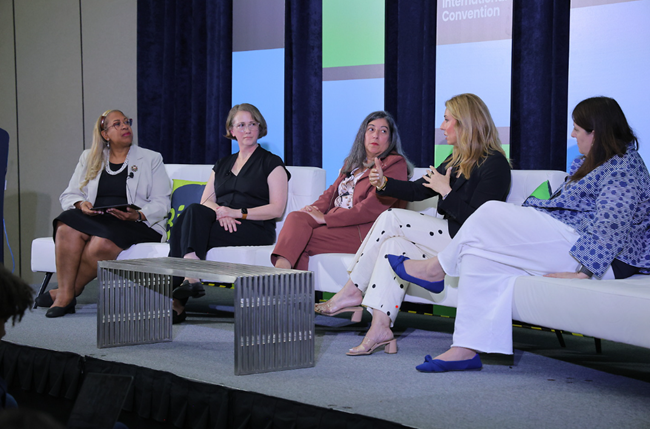
Trust in vaccines has yet to recover to pre-pandemic levels, creating a new public health threat from the potential resurgence of vaccine-preventable diseases. Arthur was among many experts discussing ways to build this trust during several panels at the BIO International Convention in San Diego (BIO 2026).
Challenges to rebuilding trust
“Communications can’t be a one-way street—the goal isn’t to repeat our message louder, but to understand people’s questions and doubts so we can meet them with information that’s relevant, understandable and useful,” according to Silvia Taylor, MBA, Chief Corporate Affairs Officer and Head of Novavax Sweden. Taylor wrote an article describing the panel she joined at BIO 2026 on rebuilding confidence in science and vaccines. (Read Taylor’s full article here.)
“We can do a better job as an industry of acknowledging where the science is not precise,” Taylor said during the panel.
The medical community can no longer simply assert its authority in hopes of returning to the pre-pandemic consensus, said fellow panelist Rebecca Alvania, CEO of the National Foundation for Infectious Diseases. Instead, they should “acknowledge the shifting sands around that trust relationship between the patient and provider,” she said. “We can’t be fighting against forces of change. We have to be navigating them.”
One action that might create misunderstanding around vaccines was the announcement earlier this year that the Department of Health and Human Services was reducing the number of standard recommendations for childhood vaccines, explained Arthur.
“It was not done in a way that was necessarily transparent or led to discussion with the public, industry, and stakeholders, and so we suddenly had a brand new vaccination schedule, and it caused a good bit of confusion,” she said.
The state perspective
While changes at the federal level have a big impact, much of vaccine policy is made at the state level.
In a panel on state vaccination policy, Kate Mevis, Executive Director of Federal and State Vaccine Policy at Merck, recalled meeting vaccine skeptics in 2008 when she worked as an aide in the Senate. Since then, anti-vaccine skepticism has grown.
“Anti-vaccine advocacy has become more organized, and there is that ability for them to have a voice at the state level, talking to legislators,” said Erin Abramsohn, Executive Director of the Infectious Disease Prevention Network.
Abramsohn said her group helped defeat more than 50 “anti-vaccine” bills in 10 states in the 2026 legislative season alone. Overall, she said, polls on the state and national level show most Americans from both parties favor routine vaccination and requirements for school entry, yet in some states anti-vaccination voices are louder.
Those states can pay a price, as we saw with the measles outbreak in Texas.
“We really are living in two Americas where your health care and your health care outcomes are dictated by your zip code,” said Julia Spiegel, CEO of GovAct.
“South Carolina, Utah, Texas, Idaho—we are seeing more outbreaks of vaccine-preventable diseases, and those are really part and parcel of seeing lower vaccination,” said Arthur. “Dips in certain communities have led to outbreaks, and those may have been prevented.”
States have taken a new approach in a time of confusion in vaccine policy. California, Hawaii, Oregon, and Washington formed the West Coast Health Alliance to encourage uptake of vaccines and “to create our own public health consensus that we’re going to follow the science,” regardless of attitudes in Washington, D.C., explained Andy Chason, Vice President of Federal Policy and Advocacy for Blue Shield California.
Messengers matter
A key to addressing anti-vaccine sentiment is to take a holistic approach that allows people to ask questions and also respects the fears motivating their concerns, experts at BIO 2026 agreed.
This approach was favored by speakers on another panel, “Innovating Against Influenza: New Breakthroughs to Save Lives,” who lamented that flu vaccine uptake among children has dropped below 50%. They said more effective countermeasures include allowing entire communities to be vaccinated at once through initiatives such as community vaccination drives.
Alvania emphasized the importance of a group effort.
“Prevention was always a team sport,” she said. “There are many players on the field that have strengths, and we have to be collaborating.”
Several experts spoke of the need to find trusted local voices, including church leaders and community activists, rather than politicians.
One voice that many people listen to is AI, already the primary source for medical advice for millions, experts said. Panelists argued the medical community should understand this and turn AI into an ally against misinformation.
“I think we’re still in this adolescence of understanding that the LLM is now a very important stakeholder,” said Deborah Glasser, Head, Specialty Care, North America, and U.S. Country Lead at Sanofi and a member of the BIO Trust in Science Working Group. But she warned that large-language models (LLMs) need high-quality evidence, noting that, at one point, 70% of the data LLMs gathered came from Reddit, which was erroneously treated as a scientific source.
As with human experts, AI needs to listen carefully—to the right sources. Fortunately, data from AI searches is constantly improving, according to Glasser. “I’m super optimistic about the day that my 82-year-old mother can have an LLM that tells her what’s going on with her biology,” she added.
Meanwhile, experts said, the vaccine community’s willingness to listen to those who may be more hesitant is also helping rebuild trust.