
Industry, academic, and policy leaders at BIO 2026 discussed how federal research funding, private investment, and public-private partnerships can strengthen the U.S. biopharma ecosystem and maintain America’s biotechnology leadership.
Biotechnology’s first 50 years were built on a uniquely American formula: world-class universities, federal research funding, venture capital investment, and partnerships between academia and industry.
The question facing industry leaders at the 2026 BIO International Convention is whether that formula can continue to deliver breakthroughs for the next 50 years.
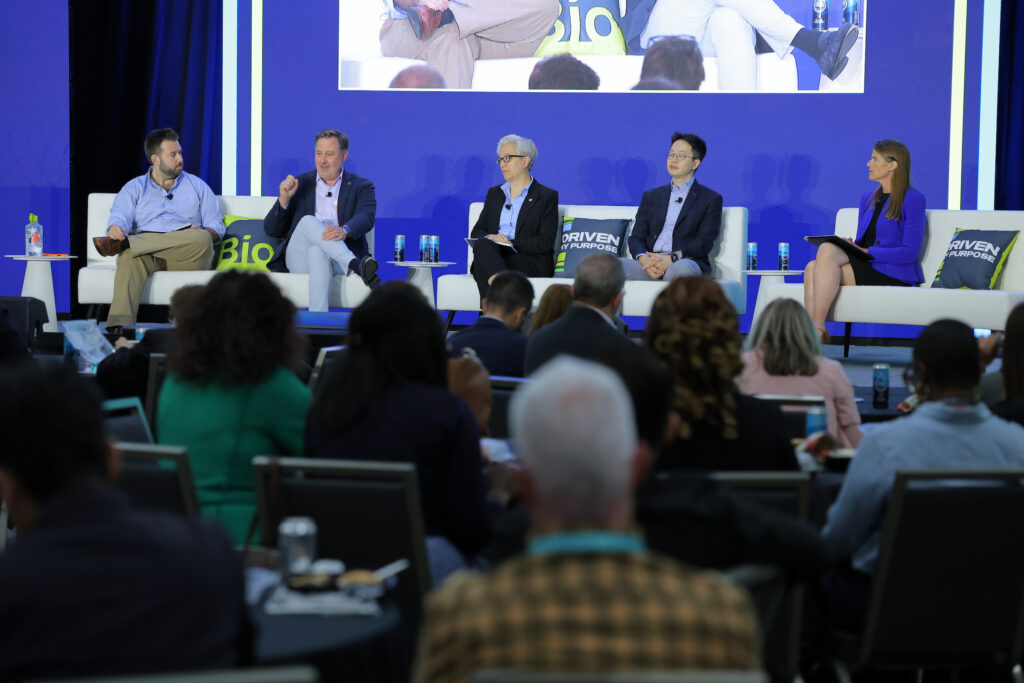
That was the focus of Tuesday’s super session, The Innovation Mandate: Strengthening the Biopharma Ecosystem for the Next Generation, sponsored by Genentech and featuring leaders from government, industry, and academia.
The biotechnology industry traces its origins to such a partnership. In 1976, venture capitalist Robert Swanson and University of California, San Francisco scientist Herbert Boyer joined forces to found Genentech, considered the world’s first biotechnology company.
“That’s what makes our system in America so special,” said Fritz Bittenbender, Senior Vice President of Public Affairs and Access at Genentech.
But speakers warned that the ecosystem responsible for decades of scientific progress faces growing challenges, from uncertainty surrounding federal research funding to increasing global competition for talent, capital, and innovation.
“When we see budget cuts happening at the NIH, that actually has a horribly negative effect on our country’s ability to be able to innovate in the future,” because it leads to an exodus of talent, research, and science, explained Bittenbender
“Capital is fungible,” said Andrew Lam, PharmD, Managing Director and Head of Biotech Private Equity at the Ally Bridge Group. “It will seek out the best innovation around the world.”
“We have to have science continue to dictate where the funding should go,” Bittenbender added.
How do we maintain American competitiveness in a global ecosystem?
“The world has changed dramatically,” said Lam. “In fact, the velocity of innovation is only as solid as the protection mechanisms and investment we put into it, and because of that, we need to think more globally. How do we continue to maintain our lead in terms of our very vibrant ecosystem within biopharma?”
China’s rise in the biotech industry is something to watch – and perhaps learn from.
“China is spending a trillion dollars right now on research,” said Bittenbender. “They have a five-year plan to dominate the bioscience industry, and it’s a very comprehensive plan. What we are missing from a policy perspective in the United States is a holistic, comprehensive plan.”
To maintain America’s competitive advantage, we need robust institutions, and the federal government must support them.
“I think there’s a misperception that if we cut back on NIH funding, other types of private investment dollars are going to step in and fill that void, and that’s simply not true,” explained Erin Trish, Ph.D., Co-Director at the USC Schaeffer Center for Health Policy & Economics. “What the research shows is that public and private funding are complements, not substitutes.”
Throughout the discussion, speakers returned to a common theme: scientific breakthroughs do not happen in isolation. They emerge from an ecosystem that connects researchers, universities, investors, companies, regulators, and policymakers. The challenge now is ensuring that the ecosystem remains strong enough to support the next generation of discoveries.
“What are the next 50 years going to be?” Bittenbender asked. “What are the new treatments? What are the new modalities? And how can government be thinking about that?”