
One afternoon in 2024, the BIO Federal Government Affairs team received a call from Hill staff who said, “We just met the most amazing family. They came down from Boston. They have a story to share, and we think you guys need to know them.”
Joe and Courtney Dion came to Washington to share their story: Peter, age 10, and Maggie, age 6, were born with limb-girdle muscular dystrophy (LGMD-R5, formerly known as LGMD-2C), a rare disease that would eventually rob the children of their ability to walk, move independently, and breathe on their own.
At the time, there was little hope on the horizon.
“Our first conversation with the Dions was incredibly powerful—it became clear that they had done their homework. They identified a company with a promising gene therapy, but which could not progress to the clinic without significant investment,” explains Michele Oshman, BIO’s Chief Patient Advocate. “They also understood that investment could very well depend on the reauthorization of a little-known, but incredibly powerful federal program called the pediatric priority review voucher (PPRV). … For the cynics out there who think that maybe patient advocacy is not truly organic, they are wrong. It really is.”
From that day, the Dions made it their mission to get the PPRV reauthorized in time for Peter and Maggie to benefit from gene therapy.
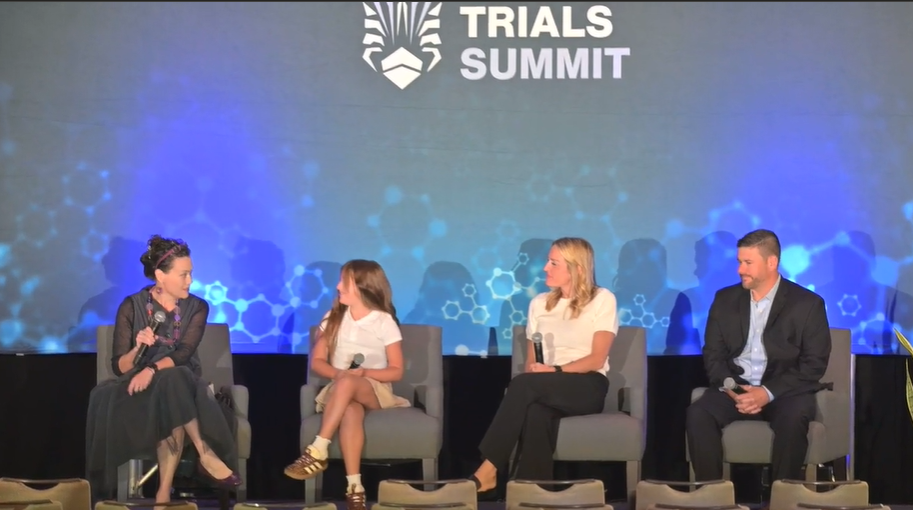
Oshman, along with Maggie, mom Courtney, and dad Joe Dion, was a keynote speaker at the Rare Trials Summit, held in Boston in September. The summit’s aim is to act as a working meeting for those responsible for advancing rare disease clinical programs.
Oshman and the Dion’s conversation was a perfect example of just how effective patient advocacy can be when patients, innovators, and Congress work together toward solutions.
What is the PPRV and how does it help patients?
Developing medicines for rare childhood illnesses is very expensive and risky because the market favors medicines that will be used in larger populations.
Enter the Rare Pediatric Priority Review Voucher program. If a company develops and achieves FDA approval for a rare pediatric disease medicine, the FDA gives them a “voucher”. This voucher acts like a fast-pass ticket. The company can use it to buy time in the form of a 6-month FDA review instead of the standard 10-month review for their next innovation. The voucher is also an extremely high value asset that can be sold to another pharmaceutical company, thus enabling the rare disease innovator to invest tens of millions of dollars back into their R&D efforts.
The program is something many small, rare-disease-focused companies use to fund their current and future work, and has been a game changer for rare disease patients.
“Our children Maggie and Peter were diagnosed with limb-girdle muscular dystrophy in 2022,” explained Joe Dion. “At first, we didn’t know what to do. There was no cure. There were no trials. But there was one company that was potentially going to start a trial; it was a waiting game.”
But not content to just sit and wait, the Dion family got to work.
“We started advocating and, fast forward to 2025, we got the first ever trial started,” he continued. “At the time, the PPRV program was something that made sense because this is an ultra rare disease. There weren’t enough patients to make it lucrative for investors to come in and invest in the typical pathway to get a drug developed. So the PPRV program was a big, big part of what helped us move things forward.”
In addition to advocacy, the Dions also hit the fundraising trail to supplement the research and development of treatment—including Joe being on Harpoon Hunters, a Discovery Channel reality TV show, to raise awareness. But an interesting thing to note about the Dion’s story is that their advocacy played a major role in bringing research into the United States.
The company that the Dions were working with was originally based in France and had already compiled pre-clinical data as a foundation for their work. It was the PPRV program that incentivized them to bring their business stateside and break the technology in the American market first.
“The PPRV program was clutch in getting it to move forward,” said Joe.
Today, the company is still working to get their treatment to market and the Dions are continuing to ring the bell every step of the way.
Navigating treatment—and recovery
“When we had the chance to be able to get our children treated with gene therapy, we put everything else on hold,” explained Courtney Dion. “We would have moved mountains. We would have gone to France. We would have gone to a third-world country if we had to. We would have sold our house. We would have done anything that we could have to have this opportunity.”
Luckily, the Dions only had to move to Florida for a short time.
And so the family moved and worked directly with the team down in Florida to navigate the clinical trial process, as well as see how it affected Maggie and Peter differently. For example, Maggie, who was able to get the treatment at a younger age, had a 92% expression in her recovery—an unprecedentedly successful amount—indicating the importance of getting these treatments out into the world faster and to patients earlier.
As Oshman pointed out, however, the Dions are in the game for the long run because there are more trials that need to be done, and more children that need to be helped. “These trials aren’t getting stalled because the medicine’s not working,” she reminded. “But because of the financing.” As such, the Dions have prioritized their fundraising efforts so that more children just like theirs can get access to these trials.
Additionally, because of the work the Dions and advocates like them are doing, the PPRV program was reauthorized in February of 2026—ensuring that doors were opening for rare disease clinical research and development, not closing.
The power of the patient voice
The Dion’s experience is reflective of the power of patient advocacy: patient voices change the world, and their stories can put a human face on complex policy issues.
Another patient advocate at the event, Effie Parks, host of the Once Upon a Gene Podcast and mother to her son Ford, who was diagnosed with CTNNB1 syndrome, opened the event by saying, “When a trial becomes a possibility, we bring our children, our hope, our questions, and our trust. We can want progress with everything we have and still be frightened by what comes next.”
As Maggie Dion explained, “I love fighting for kids who don’t get a chance to go up and talk.” Not every child has the opportunity to speak as she does, she said; it is not a responsibility she takes lightly.