

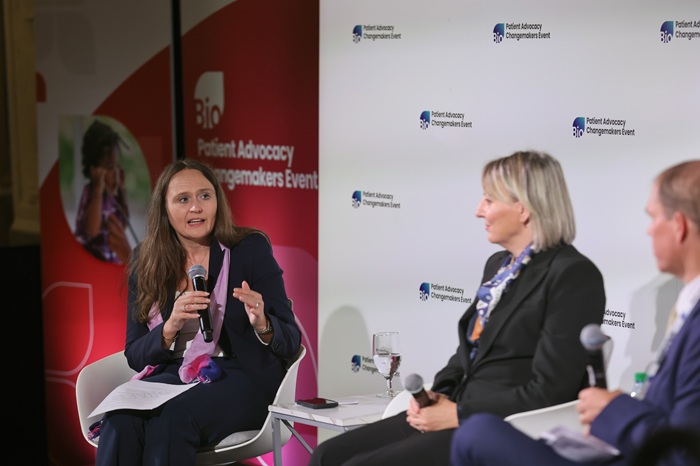
Changes brought on by the Inflation Reduction Act (IRA) often increase patient costs and reduce access, while also harming the innovation that brings new treatments, according to patient advocates.
Correcting the situation requires raising the patient voice and telling patient stories, said panelists at BIO’s Patient Advocacy Changemakers Event (PACE), in Washington DC, Oct. 22-23. PACE has been held annually for 15 years and provides a unique opportunity for patient advocates, the biotech industry, and other stakeholders to promote the development of new treatments.
“The Inflation Reduction Act was signed into law about four years ago now. Are patients better off?” asked panel moderator Karin Hoelzer, BIO Senior Director of Patient Advocacy.
On balance, panelists maintained, patients are not better off. IRA price controls clearly create a barrier to access by discouraging investment in innovative new drugs, but there are many other more direct, negative impacts on patients, the panelists said.
The out-of-pocket cap and Medicare Part D
If there is good news out of IRA it is the out-of-pocket cap on annual payments by patients whose prescriptions are covered by Medicare Part D, said the panelists, Jennifer Snow, Founder and Managing Director – Apteka, and Patrick Wildman, SVP of Advocacy & Government Relations – Lupus Foundation of America.
Both cautioned that the Part D redesign that brought about the cap also brings in some challenges.
“For people who have high costs to address their medical needs, the cap would be really important for them,” said Wildman. “But for people who don’t hit the cap, their costs may actually have gone up as a result of the IRA. And that’s simply because there’s been a shift from co-pays to cost share.”
Both he and Snow also expressed concern about what the IRA would mean for future changes in Part D.
“I worry about the long-term kind of return on investment of the Inflation Reduction Act when we’re looking ahead to the Part D redesign,” said Snow. “From a beneficiary perspective, I think we’re in for a huge, huge shift in terms of Part D. The benefit is just not stable right now, and I think longer term, we’re going to be looking for solutions on how to ensure that Part D can stay at least as great as it is now.”
One immediate challenge brought about by the cap has been an escalation of insurance companies’ utilization management practices, which create barriers to accessing drugs, according to Wildman.
Snow agreed: “We’re up to like 50% of branded drugs requiring prior authorization in Part D,” she said. “It’s just under 10% for step therapy.”
Part B and other price controls
Another area where future changes could cause problems is in Medicare Part B, which covers drugs that are administered by a professional provider. Under IRA, these drugs will be subject to price controls in 2028, and the result will likely be new challenges to access, the panelists said.
“We don’t know what reimbursement mechanism they’re going to use for providers, and the providers may be underwater,” Snow said. “If providers can no longer afford to provide those negotiated drugs, what happens to access?”
“There are real impacts on patients. And I think our role is to show what those impacts are,” Wildman said. “In the case of a low reimbursement for administering a price-negotiated drug, the downstream impacts are the patient doesn’t get that drug or they have to change providers.”
Along with the IRA, the panel also looked at other mechanisms to control prices, including Prescription Drug Affordability Boards (PDABs), which are being used by several states to control or cap the reimbursement insurers, state Medicaid programs, and public entities pay for prescription drugs.
“Much like the Inflation Reduction Act, PDABs look at drug pricing and affordability,” but from a state perspective, Snow said. “Is it affordable to the state who’s trying to set it up or affordable for the patient? Those two cannot be reconciled. And I think we see that on the federal level, too. Drug pricing is not about affordability. From a patient advocacy perspective, the more we push back on that notion, I think, the stronger the affordability story becomes.”
Patient stories
Wildman agreed that the approach states take with PDABs tends to ignore the patient’s perspective, and said that federal efforts at drug price control are similarly challenged. He said patient advocates are trying to make the Centers for Medicare & Medicaid Services (CMS) take patients into account when deciding on their actions.
“I think that is part of the solution, making sure that CMS is fully engaged with the patient community and is looking at us not only as a partner in ensuring the stability of the program but also the future of the program,” he said.
Snow reached out to the audience of patients and patient advocates at PACE, asking for their help by sharing their stories.
“Those who are patient advocates, your experiences, the experiences of the people you represent, are critical to helping inform our white papers, or issue briefs, or comment letters. Or you can go to CMS yourself and share your experience,” Snow said.
She added that CMS used to listen to taxpayers who fund them and patients who used their services, but that has changed.
“Over time, it has felt more like there are other stakeholders who are getting the voice. And I think it’s time to wrench that back and make sure that the patient voice is heard. For that, we’ll need your stories,” Snow said.