Skip to content


We sometimes imagine the inventor of a patent as a lone vanguard leading the charge toward innovation, but in the era of team research and collaboration, joint inventorship is far more common, especially in a complex field like biotech.
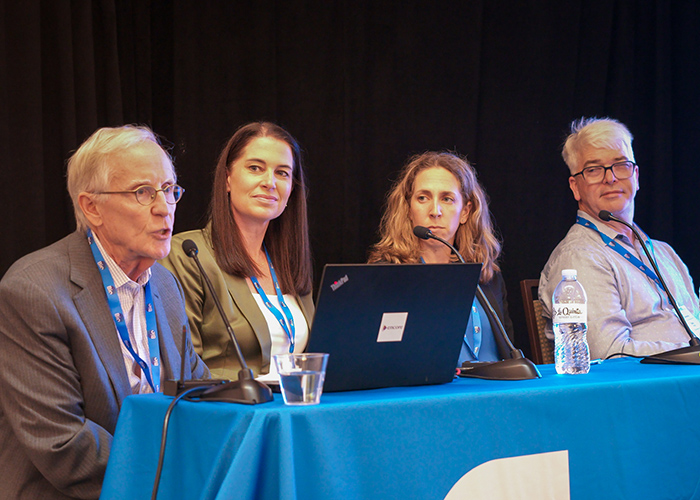
Universities, companies, and government institutions must understand the many challenges involved in determining joint inventorship of a patent, according to a Nov. 17 panel at the 2025 BIO IP Conference in Southern California.
Years ago, a court called joint inventorship “one of the muddiest concepts in the muddy metaphysics of patent law,” said moderator Don Ware, Partner at Foley Hoag, quoting from the 1972 decision in Mueller Brass Co. v Reading Industries Inc.
Since then, the courts, including the Federal Circuit, have provided considerable guidance. In its presentation, the BIO panel defined the elements of joint inventorship and reviewed hypothetical case studies to explain the nuances of contested inventorship.
Joint inventorship elements in practice
The panel began by describing the key elements of inventorship under U.S. law: conception, collaboration, and corroboration. An inventor must have contributed significantly to an invention’s conception, collaborated in its development, and, to correct an issued patent, be able to corroborate their contribution with contemporary evidence, explained Erin Foley, Ph.D, Counsel and Registered Patent Attorney at Foley Hoag.
Putting those principles into practice can be tricky.
The panel analyzed a hypothetical case where two scientists, Dr. Harris and Dr. Davenport, discussed their research on two occasions in the course of a year. When Dr. Harris later patented a vaccine that was, in part, informed by these conversations, Dr. Davenport’s university sued, alleging that Dr. Devenport should be named as an inventor.
The hypothetical mirrored the 2011 University of Utah v. Max-Planck case. The panel framed the issue as an issue of collaboration rather than contribution: offering ideas is not enough, absent proof that the putative joint inventors collaborated to solve a problem.
Another case study investigated who could be listed as a joint inventor on an especially complex invention—perhaps one developed over the course of many years.
The panel posited: Dr. Catherine Parker, an MIT immunologist collaborating with BIG, a large biopharmaceutical company. After a breakthrough in identifying the method by which SARS-CoV2 enters cells, she tells BIG in confidence of her discovery. BIG uses its proprietary mouse model to test Dr. Parker’s findings, files a patent application on the COVID-19 treatment method, and names only its own scientists as inventors. However, before BIG conducted the mouse studies, one of BIG’s scientists inadvertently revealed Dr. Parker’s discovery to a science reporter, who wrote a story about it, with the result that the discovery entered the public domain before complete conception of the invention.
Citing the real Dana-Farber v. Ono case, the panel said Parker would be a co-inventor, based on her significant contribution to conception, communicated in confidence to BIG before conception. Complex inventions often involve multiple contributors over time, and publication doesn’t negate important contributions leading to conception, the panelists explained.
In another hypothetical, two scientists, Linus and Marie, working at different institutions, are both researching a beetle toxin with therapeutic potential. They meet at a conference and discuss their work. Linus immediately begins work at his institution the next day to test the toxin, eventually developing stable formulations and demonstrating some efficacy.
Marie delays her work for a year but later develops a more effective formulation. The two collaborate only afterward. Later, Linus files a provisional application that eventually matures as a patent. Marie finds out about it and demands to be added as an inventor.
Citing the UC–Broad CRISPR dispute, the panel emphasized that, without collaboration prior to conception, joint inventorship doesn’t apply—even if later collaboration occurs.
What about AI?
Lastly, the panel explored inventorship in the era of AI.
The panel described a scientist, Marco, seeking a new drug for brain cancer by looking for antibodies to neutralize certain protein mutations. He talks to Jyoti, an AI expert at his company, and asks her to use the company’s proprietary AI program that provides models for predicting antibodies worth investigating.
Working with Laura, a programmer, they are able to select three promising candidates, and Marco files a patent application.
Is Marco an inventor, or did the AI agent invent the antibodies? The short answer: invention is a fundamentally human endeavor.
According to the U.S. Patent and Trade Office (USPTO), “AI programs cannot be listed as inventors on patents.” The USPTO has also said that a person using AI must still significantly contribute to the invention: “If a person merely inputs a problem into an AI program, that person is likely not an inventor of any AI output that solves the problem.”
How to avoid risks surrounding joint inventorship
To avoid the pitfalls surrounding joint ownership, the panelists recommended several best practices.
The first step, said David Pauling, Chief Administrative Officer and General Counsel at Sutro Biopharma, Inc., is a paper trail, starting with an inventorship memoranda. Pauling recommends an intellectual property contribution form, over an inventor disclosure form.
“Your inventors are not experts in determining who might be an inventor,” he noted, “but they are quite good at telling you who they actually worked with on stuff.”
Pauling’s second recommendation is to have patent conversations early, instead of with a room of fired-up people feeling they’ve been cheated out of inventorship on a patent.
“We routinely, every couple of years, give our scientists a little talk about our friend, the patent,” said Pauling. “We go over the distinctions between scientific authorship and inventorship when the temperature is low and the conversation is still boring.”
Another way to ensure caution ahead of time is to remind people that inventors tend to get deposed if there is ever a legal dispute, Pauling adds.
In the case of external collaborations with third parties that lead to patents, Rachel Senturia, Head of Intellectual Property and Licensing at Arc Institute, recommends caution during confidential discussions. “Best practice would be to file a provisional prior to confidential disclosures with third parties,” she said.
Another important document is a collaboration agreement. “There is no excuse not to have a collaboration agreement for every collaboration you do,” said Pauling.
Lastly, Pauling recommends robust onboarding and offboarding. Talk about company IP policies with new hires and with departing employees. Make sure these conversations are documented, so there is no doubt that requirements were met.
Panelists recommended that, throughout every research collaboration, patent counsel should stay on top of inventorship and address issues before they become problems.