Skip to content


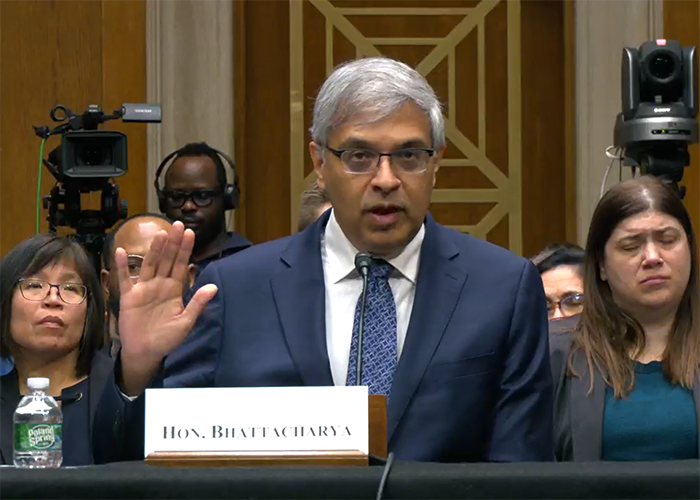
National Institutes of Health (NIH) Director Jay Bhattacharya acknowledged there are no studies indicating a link between any vaccine and autism as Senators pushed for a more science-forward approach to vaccines and research funding, in a Feb. 3 hearing.
Senators also questioned the NIH director about sudden changes to recommendations for childhood immunization and cuts in NIH grants in the Senate Health, Education, Labor & Pensions (HELP) Committee hearing on “Modernizing the National Institutes of Health: Faster Discoveries, More Cures.”
Bhattacharya, the lone witness for the hearing, took the opportunity to lay out his own plans for modernizing the NIH, which saw its budget increased by Congress that day, with the approval of a new spending package.
In response to questions from Ranking Member Bernie Sanders (I-VT) about vaccines, Bhattacharya said: “I have not seen a study that suggests any single vaccine causes autism.”
Shortly afterward, Sen. Maggie Hassan (D-NH), noted that several “vaccine cynics” were appointed the week before to the Interagency Autism Coordinating Committee, which guides federal programs addressing autism, and asked Bhattacharya to repeat his statement.
“I have not seen any scientific study for any other vaccine that convinces me that it causes autism,” Bhattacharya responded.
“That theory has been debunked by a broad set of studies with over a million children,” Sen. Hassan said. “And relitigating debunked theories about vaccines doesn’t get us closer to the answer of what causes autism.”
Plans for NIH modernization
Bhattacharya’s own written testimony, and several subsequent remarks, focused on his plans for modernizing and streamlining the NIH.
He described of a plan to centralize peer review for grants, cooperative agreements, and research and development contracts within the NIH Center for Scientific Review, “consolidating review activities previously conducted across NIH Institutes and Centers to improve efficiency and consistency.” Bhattacharya said the approach would save more than $65 million annually by eliminating duplication.
Another change Bhattacharya mentioned was NIH’s new unified funding strategy “to promote clearer, more consistent award decisions across its extramural funding portfolio” and align research investments with NIH-wide priorities.
“Ensuring that NIH-funded research results in Americans living longer, healthier lives is an overarching priority of mine,” Bhattacharya wrote.
Questions on the vaccine schedule
Committee Chair Bill Cassidy, MD (R-LA) and Sen. Lisa Blunt Rochester (D-DE) had questions about the Jan. 5 announcement that the Centers for Disease Control and Prevention (CDC) would only routinely recommend 11 vaccines for all American children as opposed to the 17 it previously recommended.
Bhattacharya maintained the changes were made to reflect Denmark’s immunization schedule, but Sen. Blunt Rochester said there was no comparison between the U.S. and Denmark.
“Denmark has socialized medicine, universal health care. The United States does not. Parents in Denmark are entitled to paid parental leave. In the U.S., this is not guaranteed,” Sen. Blunt Rochester said.
Cassidy maintained that modelling U.S. public health on Demark is “a crazy idea,” because the level of healthcare in America varies widely.
“If you’re wealthy from Boston, you’re going to have one experience. And if you’re less wealthy, if you’re poor from a rural town in Louisiana, you’re going to have another,” said Cassidy, slamming his desk as he added: “Now if we pattern after the place that is wealthy, we’re not meeting the needs of those that are poor.”
Cassidy called the reduction in recommendations for routine childhood vaccinations a threat to public health, saying the “cacophony of notes” on vaccine messaging “is going to further undermine trust” in vaccines.
“My fear is that we’re going to have meningococcemia with children losing fingers and legs and noses, because now we don’t vaccinate routinely for meningococcemia—rare but highly consequential,” Cassidy said. “This is dangerous.”.
“I think we have to reestablish trust. Absolutely, I share your goal entirely,” Bhattacharya said. “The question is the method of reestablishing trust.” He maintained that Denmark had established trust among the populace with its vaccine regime.
Funding cuts
Regarding cuts in NIH funding Sen. Hassan said there were fewer research grants for cancer because of disruptions to National Cancer funding and asked if NIH had studied the impact of these cuts on patients.
Bhattacharya countered that NIH worked to restore all disrupted grants and that all NIH funding for last year was spent, but Sen. Hassan maintained that actual work was prevented because of the disruptions.
Sen. Tim Kaine (D-VA) noted NIH lost nearly 4,000 employees, including 1,100 at the doctoral level. “You preside over an agency that has shrunk dramatically,” he said, asking how NIH can continue to do its work in this situation.
Bhattacharya maintained that the agency had kept pace with its workload, handling all grant reviews by the end of the fiscal year.
Sen. Susan Collins (R-ME) said NIH funding cuts “could jeopardize our country’s global leadership in medical research” by reducing research, as well as the number of researchers.
“China and Europe are actively recruiting the very best young minds that we have in this country. It used to be the flow was the opposite direction. We got the best of the best from around the world,” she said. Now, however, young scientists are “considering ‘Is there room for me in America to pursue my passion?’ ”
Bhattacharya agreed: “Funding early-career scientists is not just a scientific priority, because that is often the source where new ideas come from, but is also, as you say, a national security priority, and is a priority of mine specifically.” He promised efforts to ensure that young scientists are included among those receiving NIH grants.