
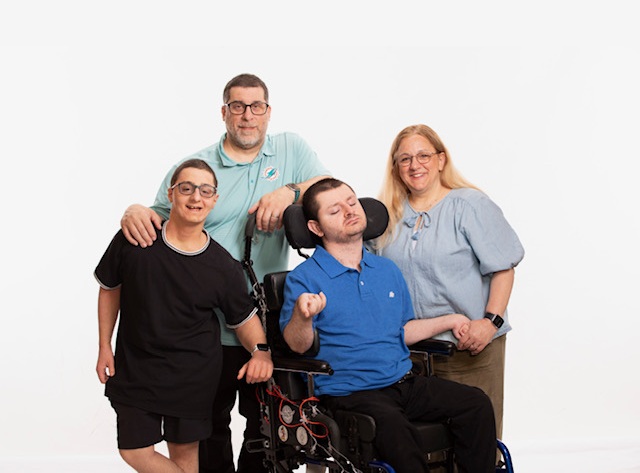
For the Sereno family, time has always been important.
And for Lina Sereno, trusting her gut made all of the difference when it came to her two sons: Salvatore and Giovanni.
“My older son, Salvatore, was diagnosed with metachromatic leukodystrophy (MLD) in October of 2009,” explains Sereno, “but it took approximately seven months to find out what was happening to him. I took him to six different doctors, and each one suggested that he had ADHD. I agreed to medication for two months. Instead of improving, he became worse.”
It was during this time that Sereno recalls the night her son Salvatore became dazed and unresponsive. “I notified his doctor, and that finally prompted the MRI that got us the MLD diagnosis,” she says. “All these years later, I believe he may have experienced a seizure.”
Shortly thereafter, Sereno got her younger son Giovanni tested as well and found that he too had MLD. His early diagnosis gave him access to early treatments that Salvatore never had the opportunity to get. “I know with all my heart that Giovanni is thriving today because of that early diagnosis and treatment,” says Sereno.
“The journey felt incredibly long and lonely,” Sereno recalls. “No parent should have to fight so hard to get answers while their child is losing precious time.”
As such, the Surge to Save Newborns Act (H.R. 10571), a bipartisan bill introduced in September has been introduced with the aim to close critical gaps in state-level infant health screenings so families like the Serenos don’t lose precious time.
To discuss both the Sereno family’s own personal journey, as well as the importance of passing H.R. 10571, Bio.News sat down with Lina Sereno.
Newborn screening for rare disease is hope for families
“The fact that a disease is rare makes newborn screening even more important,” explains Sereno. “Most parents have never heard of MLD until it affects their own family. By the time symptoms appear, it may be too late to prevent irreversible damage.”
It was 17 years ago when Salvatore and Giovanni were diagnosed, and the Sereno’s story shows just how impactful time (both gained and lost), and healthcare innovation have been to their family
“At that time, the only treatment option available to us was a bone marrow transplant,” Sereno says. “My husband and I made the best decisions we could for both of our sons based on the medical knowledge and treatment options available.”
Today, much more is understood about MLD—especially the importance of early intervention. While a new gene therapy has been approved for MLD the risk remains for children diagnosed after symptoms begin as some of the damage may already be irreversible.
“I wish I had known how drastically our lives would change,” Sereno says. “Raising two boys with MLD has been incredibly difficult, but it has also shown me the extraordinary strength of our family and the power of love. There have been challenges I never could have imagined, but there has also been so much joy and beauty.”
Following his bone marrow transplant, Giovanni has remained almost symptom-free for 17 years. “He goes to school, plays video games, has friends and experiences most of what other kids his age do,” Sereno says.
Unfortunately, for Salvatore, the delay in his diagnosis has had distinct effects.
“Salvatore’s disease progressed rapidly during his bone marrow transplant,” says Sereno. “He walked into the hospital and left fully disabled and dependent on a G-tube for nutrition.”
Today, Salvatore is dependent on his family for care.
“His story is why I want other families to have the opportunity that came too late for him,” says Sereno. “Even if newborn screening identifies just one child a year who can benefit from early treatment, it is worth it. That is one child, one family and an entire lifetime that could be changed.”
Rarity should never determine whether a child gets that chance, she says. Newborn screenings mean hope for families.
“Instead of constantly worrying about the unknowns of this disease, parents could have information, access to specialists and the opportunity to act early,” she continues. “Every family deserves that chance. No parent should have to learn that their child has a devastating disease only after symptoms appear and precious treatment time has been lost, when the possibility of treatment is either gone or would not be as beneficial.”
From the RUSP decision to real-world screening
MLD and Duchenne muscular dystrophy were added to the Recommended Uniform Screening Panel (RUSP) on December 16, 2025—a major milestone for families and advocates. However, a federal recommendation does not automatically provide states with the resources to implement it.
“Rather,” Sereno explains, “each state must take the necessary steps to add MLD to its newborn screening panel. That process may require legislative or regulatory action, laboratory validation, specialized equipment, staff training, clinical follow-up systems and additional funding.”
While the federal recommendation by RUSP is an important first step to resolving this issue, it is not enough if states cannot implement said recommendations in a timely and efficient manner.
“Scientific advances and new treatments are creating opportunities to identify and treat babies earlier than ever before,” explains Sereno. “But without adequate funding, states may not have the resources to implement these screenings in a timely manner.”
It doesn’t matter how many healthcare advancements are made if families can’t (or don’t know to) access them.
“For families who have spent years advocating for newborn screening, this decision to include MLD and Duchenne muscular dystrophy to the RUSP represents hope,” Sereno reminds. “It acknowledged that early detection matters and that babies should have the opportunity to be identified before symptoms appear.”
Historically, implementation of a newly recommended condition can take five to six years in many states, and in some cases, considerably longer, which ultimately translates to missed opportunities for early diagnosis and treatment.
“State laboratories may lack the funding, equipment, facilities or trained personnel needed to establish a new screening test,” she continues. “They must also develop testing protocols, validate results, coordinate confirmatory testing and establish pathways for referring affected newborns to specialists.”
This has translated to the inclusion of MLD and Duchenne muscular dystrophy varying from state-to-state, creating what caregivers refer to as the “birth lottery,” where two babies with the same condition can have very different opportunities simply because they were born in different states.
“The state-by-state approach is profoundly unfair,” says Sereno. “It is heartbreaking to know that the state in which a baby is born can determine whether a potentially devastating disease is detected early enough for treatment to make a difference.”
Newborn screening should not depend on a family’s ZIP code, financial resources or ability to advocate for their child.
“These are essential steps, but states should not have to face these challenges alone. Without dedicated resources and coordinated support, even a strong commitment to newborn screening can be delayed by financial and operational barriers,” Sereno adds. “Every newborn deserves equitable access to screening for conditions on the RUSP, and every state needs the resources to make that possible.”
“Our work is not finished,” explains Sereno. “We must now ensure that states move forward with implementation so that this recommendation translates into real access to screening for newborns across the country.”
Surge to Save Newborns bill: Turning a federal recommendation into action
The Surge to Save Newborns bill would allow the progress made through the RUSP to go beyond just the recommendation of addition of new diseases by requesting $35 million a year for 5 years to ensure every state is screening for the 40 conditions on the RUSP plus 2 additional conditions not yet nominated.
“We need to have a coordinated national effort that brings together families, patient advocacy organizations, clinicians, laboratories, policymakers and other stakeholders to ensure that states have the support necessary to put recommended screenings into practice,” Sereno argues. “That means investing in laboratory capacity, testing technology, personnel, training and the infrastructure needed to identify affected newborns and connect them to timely follow-up care.”
Federal funding is a critical part of this solution and could help states move more quickly while promoting a more consistent and equitable approach to implementation nationwide, she says.
States should not have to choose between competing public health priorities or delay implementation because they cannot afford the necessary resources.
“Dedicated federal support could help accelerate implementation and reduce the disparities that currently exist across state lines,” Sereno explains. “This is an investment in prevention, early diagnosis and the future of our children. The cost of implementation must be weighed against the potentially devastating human and financial consequences of a missed or delayed diagnosis.”
Congress must act
When asked what she would say to congress regarding H.R. 10571 Sereno says she would implore them to think about the families behind these decisions.
“Think about the parents who spend months visiting doctor after doctor, desperately searching for answers,” she asserts. “Think about the children who could have received treatment before symptoms began but were not identified in time.”
Adding a condition to the RUSP is the beginning of the promise, Sereno says, not the fulfillment of it. Without funding, that promise may remain out of reach for the very babies who need it most.
The Surge to Save Newborns is about turning that promise into action.
“I urge policymakers to support the Surge to Save Newborns initiative and the legislation needed to provide states with dedicated implementation funding,” Sereno implores. “We have the knowledge. We have the treatments. We have the federal recommendation. Now we need the funding and the national commitment to make newborn screening a reality for every baby, in every state.”
Please act now and reach out to your congressman to support the Surge to Save Newborns https://surgetosave.org/act-now/
To get more involved and join our coalition, you can reach out to: Elisa Seeger elisa@aldalliance.org