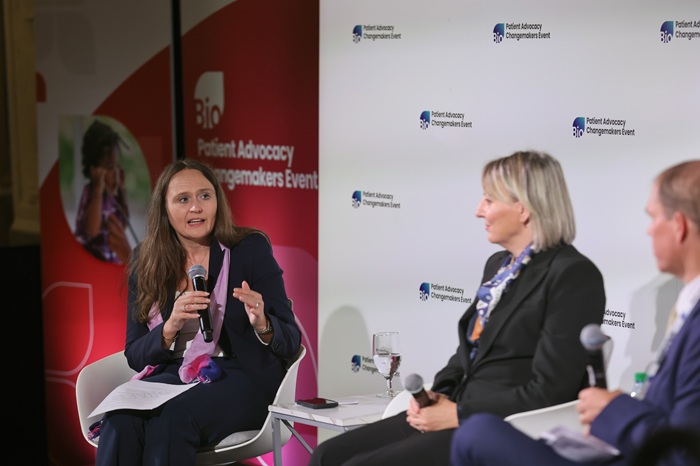

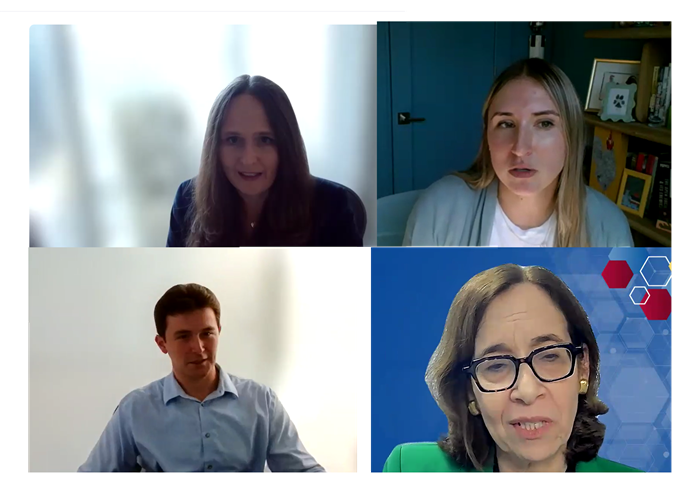
“What does good advocacy look like? Why do we advocate? And what are some tips and tricks for effective advocacy?” asked Karin Hoelzer, Senior Director of Patient Advocacy at the Biotechnology Innovation Organization (BIO).
Her questions kicked off BIO’s October Coffee Chat, Advocacy in Action, which welcomed patient advocates from across the healthcare community. While BIO’s Coffee Chats are a monthly occurrence, this month’s chat buttressed BIO’s Patient Advocacy Changemakers Event (PACE), which took place on October 22 and 23 in Washington, DC.
The event brought together patient advocates from across the country and across therapeutic areas, providing a forum to share insights, exchange information, and make new connections in the pursuit of better access to and affordability of therapies for patients.
What makes an effective patient advocate?
Every advocate’s story is different. Every advocate comes to patient advocacy with a unique drive behind why they do what they do—some coming from the patient perspective, some from the caregiver perspective, some from a community health perspective. Yet, not matter the background or policy issue at hand, advocacy is empowering—one of the many things effective advocates have in common.
“Advocacy is an opportunity we have in our country we all need to take advantage of and help folks develop those skills not only in our own community but in other communities because it really does matter,” said Jenny Luray, Senior Vice President of Strategy and Public Engagement, Research!America, “So many Americans think that they don’t have as much power as they do.”
Amanda Krzepicki, MPH, Policy Director at the Autoimmune Association, agreed. She found her start as an AmeriCorps Community Health Corps member at a federally qualified health center just across the river in Alexandria.
“While I was there, I saw the stark inequities that impact this region, as well as across the country, and how people rely on community health centers and what a robust resource they are for communities,” she recalled. “So that really made me want to jump into the state policy space.”
And that motivation has remained a driving force for Krzepicki. “Watching that shift in lawmakers when they realize someone is so passionate about an issue has always been, I think, really fulfilling, and even more so watching bills get introduced because of it.”
Advocacy provides agency and the power to change the status quo.
“I think it’s so important to be able to tie real patient stories to topics that can be quite complex at times. An area that I have worked on for quite some time is patient access, especially the issue of copay accumulators, copay maximizers, and alternative funding programs, and that certainly is a slow and drawn-out process,” said Brian DuVal, MPH, Director of Patient Advocacy at BIO. “But there have been wins, especially at the state level, and I’ve been pleased to have been part of some of those. So, in general, being able to bring patients together to help demystify some of these complex issues has been very fulfilling.”
But, breaking such complex issues down and demystifying health policy in ways that are compelling to decisionmakers is not always easy. So how are DuVal, Krzepicki, and Luray training the new class of patient advocates? And what have been some of the biggest lessons learned while working on the Hill?
Paying it forward: Training the new class of patient advocates
Having a hands-on approach to bill making, Krzepicki said, has been one of the most effective motivators for new advocates.
“Watching a patient react to a bill getting introduced, an office agreeing to get a co-sponsorship on, and the feeling of hope that it elicits is very impactful. I think sometimes we can become quite jaded,” Krzepicki said, “but watching the patients experience success and feel so hopeful can remind us all to be hopeful, and then we ultimately get the result.”
And patient advocates have been able to advance key legislation to improve patient access. But not every win results in a bill passing the House and Senate—or even just getting introduced. And not every step needs to be made at the federal level.
“The small wins definitely count,” reminded DuVal. “Keeping advocates motivated between these really big legislative pushes, especially when things may feel slow at times, it is very important to celebrate the small wins and also really understand all the different forms that advocacy can take.”
Many issues at play today—prescription drug affordability boards, vaccine access and more—are happening at the state level, making advocacy more of a two-hander than a straightforward process.
Luray echoed her position, saying: “I’d like to see more patient advocacy groups in districts because that’s where you’re most likely to get more of the members’ attention. Forming events with a local healthcare provider, the Lions Club or women’s organizations, whatever works in terms of your disease area, creating those opportunities, all of it is really important. When that member meets you on the ground, they don’t forget it.”
United front: Hill days and fly-ins
Another element of patient advocacy that the speakers discussed was Hill days and fly-ins, which can help policymakers see just how big an issue is through the sheer number of advocates that are at their door.
And in today’s world, that can happen both physically and virtually, increasing both access and affordability in the very functioning of advocacy itself.
“We have done a virtual fly-in in the past,” Krzepicki said. “If you have advocates spread out across the country, and you’re maybe a smaller organization, the cost to do a virtual fly-in is much more reasonable than bringing people out and accommodating travel.” Though in-person is still best practice, Krzepicki said.
“When I was in the consulting space, it was incredible to bring patients to the Hill and to tell their stories, to connect with lawmakers, and I think even more importantly, to connect with staffers,” Krzepicki said. “People are often quite focused on the lawmaker, but a lot of the time, if you can relate to the staff and they have a personal tie, they can use their personal connection with the lawmaker to also sway an issue area.”
This focus on Hill staffers was echoed throughout the panel, especially considering the fact that staffers often long outlast the legislators themselves. So the trick, the panelists explained, was to be a resource to these staffers even outside of your policy focus.
“When I was on the Hill, the advocates that I relied on were those that always came in with a lot of information,” Luray recalled. “I never felt they were like gaslighting me, and they were willing to answer questions and be a resource on things that might not be on their top list, but they were able to be helpful.”
Information: An advocate’s greatest asset
Advocates and volunteers have to stay informed, both about which legislators have strong ties and interests in which issues, as well as about the policy issue itself, and adjacent policy concerns—which is a never-ending process, in particular in today’s environment where so many patient access issues are interconnected.
“It’s keeping advocates really informed and giving them information along the way so they’re learning as time goes on, and developing expertise,” Luray said. “I think it’s very satisfying to people as they get more experienced and comfortable with advocacy than they were maybe three years ago. But it’s a constant effort. You constantly have to be in touch with people.”
That is even more important this year with the midterms on the horizon. The congressional landscape is changing, and advocates need to be ready.
“As the new Congress comes in, there’s going to be a lot of new staff,” Krzepicki said. “So I do think at the beginning of next year we’ll be doing a little bit of education around our issue areas and things like that.”
One way that advocates can prepare themselves is to come to BIO’s monthly coffee chats, where they can talk about the healthcare policies that are impacting patients the most and connect with fellow advocates to learn and plan for future work.