Skip to content


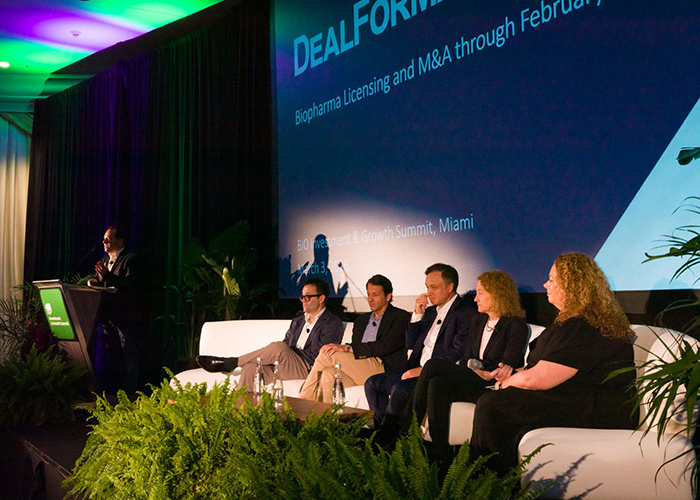
We could be in for another big year of biotech M&A. A busy 2025, in both licensing and M&A in biopharma, saw over 4,000 deals and more than $600 billion in headline value—and 2026 seems to be keeping up this momentum, according to an expert at the BIO Investment and Growth (BIG) Summit.
“It’s been a very active runoff through the tail end of last year,” Chris Dokomajilar, Founder and CEO at DealForma, told a March 3 BIG panel entitled M&A and Licensing in the Year Ahead? “In terms of licensing, where we’re seeing a lot of transactions, were quite busy.”
In fact, as Dokomajilar explained (among other metrics), there were a total of 4,341 deals in 2025, compared to 3,883 in 2024, and the $606 billion in total deal value was higher than the $421 billion in 2024. The $291 billion in upfront cash and equity of 2025 was an improvement over the $191 billion in 2024. Notably, large cap biopharmas signed fewer, higher-value deals, with 255 in 2025, compared to 294 in 2024.
So what can small biotech expect when it comes to partnering in 2026?
Understanding the M&A landscape
“M&A by nature is peripatetic or idiosyncratic,” Andrew Rymer, Partner at Centerview Partners LLC reminded panelists. “It comes in fits and spurts.”
That being said, companies last year, and into this year, are still acting aggressively, so it is important to understand how that translates. The existence of fewer, but higher-dollar deals last year could be read as a good sign, according to Rymer.
“Oftentimes, when you see a pharma looking at 10 things, there’s probably less of a chance that something gets done than if they’re only looking at two and actually focusing on them,” he said. “It’s the window shopping element.”
And as far as this year goes, as the panel observed, there was a bit of an inhale after a very active 2025, but that quiet on the surface level may be covering an active underbelly, giving a reason for optimism for 2026. With that in mind, companies can plan their strategy to fit the traditional ebbs of a fiscal year with a pre‑summer rush, and renewed action toward year‑end.
How small (and big) biotechs know when to take the jump
The case study for successful partnering on the panel was Sharon Mates, Former CEO & Chair at Intra-Cellular Therapies, who sold to J&J for $14.6 billion at the start of 2025—and as her story showed, the success of 2025 M&A was in the rigor of deals, not just the dollar amount.
“We started the company in 2002. And in December of 2024, J&J came knocking on our door,” Mates explained. This was despite the fact that they had not gone out to sell the company, but were rather in the process of building the company at the commercial stage after their first product for schizophrenia and their second product for bipolar disorder successfully went to market.
The company was approaching $700 million in revenue and not looking to sell, so what changed their minds? “When you have an interested party, what is the best route? What’s the best for patients?” Mates asked. It was a question that gets to the heart beneath the M&A numbers for biotech: these partnerships are happening as aggressively and in as focused a fashion as they are because companies are ensuring that access is primary to their business strategy.
When the finances meet patient access—that is when companies know to jump.
Looking forward to what is driving deals
The financing environment is improving, but still notably difficult for biotechs across the spectrum. Raising money, at the end of the day, is tough.
So is that impacting the deal-making environment that we’re seeing now? Is there more or less interest in companies to do deals right now because they can’t actually fundraise? Or is it the challenge of fundraising not having an impact on deals?
As may be expected, the answers to these questions are complicated.
“If we go into historical perspective, you go from 2010 or 2012 to the beginning of 2023, most any deal of scale—$500 million or so—was with public companies,” noted Rymer. But when you look at years like 2023, ’24, and ’25, Rymer added, half the volume of scale deals were private companies.
“These were companies that theoretically should have gone public and either couldn’t get the valuation and market wasn’t there, whatever it was,” he said, “and they continued on their journey, building good science, and then, pharma built the muscle to go acquire private companies at scale, and they got very good at it.”
That all being said, Rymer thought this year would be a “return to normalcy,” with less private-company M&A.
Regardless of market movements, if small biotechs are keeping their options open for exits, it is important to first and foremost make sure that they are prepared and keeping house as a company, said Marcos Cortes, Managing Director, Corporate Transactions Group at Alvarez & Marsal. This can involve setting up a governance structure, managing road shows, or establishing a learning process so that companies can find the right partners and connect as needed, he said.